A “First Window” into Huqoq
The exhibition functions as a preliminary visitor centre, offering an introduction to a site that is still undergoing excavation, conservation, and development. Visitors are invited to explore the landscape, the ancient village, the synagogue and its mosaics, the underground hiding complexes, and the archaeological discoveries that continue to reshape our understanding of Huqoq.
At its heart is the original Samson Carrying the Gates of Gaza mosaic—the only original Huqoq mosaic currently on public display—presented alongside photographs, reconstructions, the village model, and finds from the hiding complexes.
Rather than simply displaying archaeological objects, the exhibition tells the story of how fragments of architecture, mosaics, installations, and everyday objects come together to reveal the life of a Jewish community that flourished between the second and fifth centuries CE. It highlights the intersection of archaeological research, conservation, education, and public engagement, showing how Huqoq is evolving from an active excavation into a shared cultural heritage site.
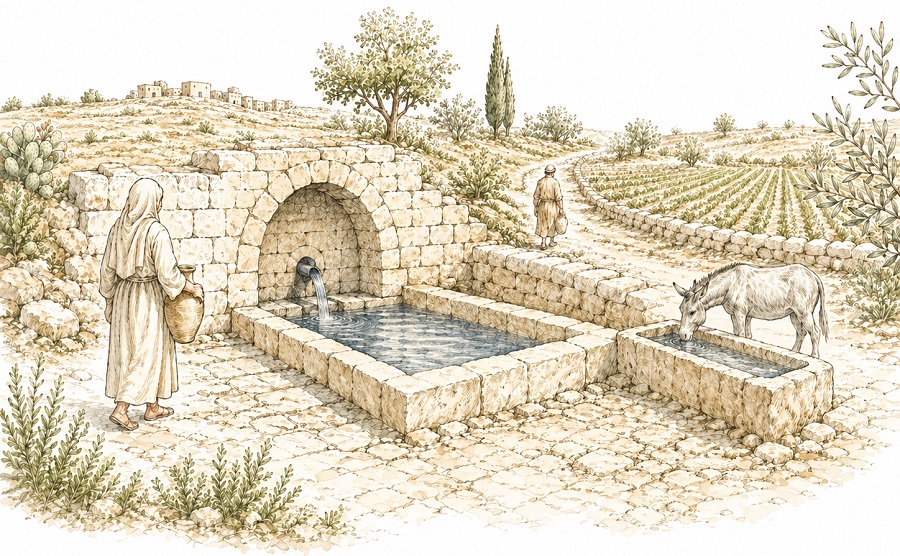
AI-generated visualization of the Huqoq Spring.
"Secrets of Huqoq": More than an Exhibition
The exhibition forms part of the broader initiative to prepare Huqoq as a heritage site open to the public in the coming years. This effort is carried out in partnership with KKL–JNF, the Israel Antiquities Authority, the W. F. Albright Institute of Archaeological Research, the U.S. Department of State through the Bureau of Educational and Cultural Affairs' Cultural Heritage Center, the U.S. Embassy in Jerusalem, the Jordan Valley Regional Council, the Yigal Allon Centre, and additional partners. It presents the results of the Huqoq Excavation Project directed by Prof. Jodi Magness, alongside the Israel Antiquities Authority’s educational and community excavations conducted at the site since 2017.
In this sense, "Secrets of Huqoq" is more than an archaeological exhibition. It is the first stage in Huqoq’s public story—an invitation to discover the site, understand its significance, explore its discoveries, and become part of its next chapter.
What Awaits You in the Exhibition?
Model of Ancient Huqoq
A reconstruction of the village as it may have appeared around 1,600 years ago, based on archaeological excavations, surveys, comparative research, and informed interpretation. The model illustrates the synagogue, houses, lanes, agricultural installations, water cisterns, and the spring at the foot of the hill. It is intended as a scholarly reconstruction rather than a definitive representation.
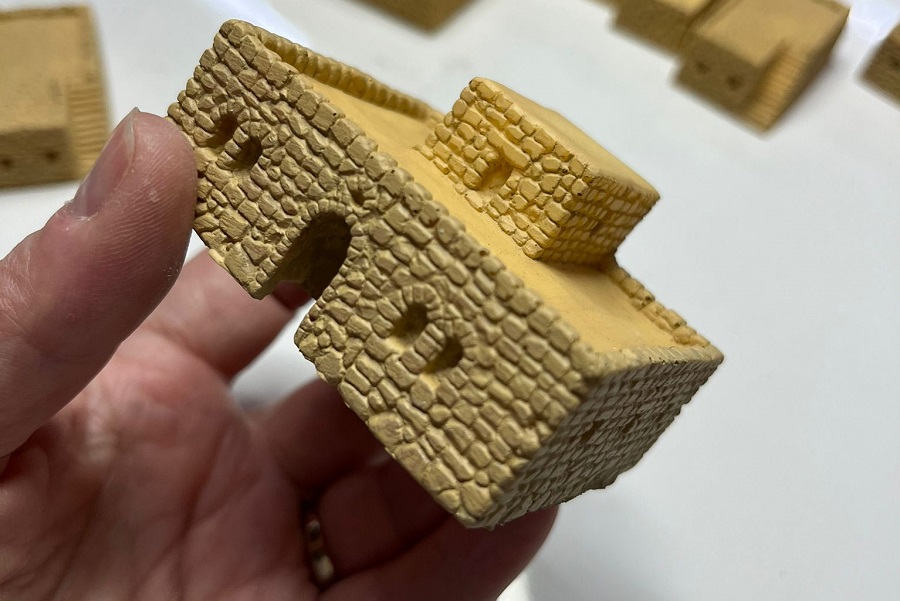
Models of buildings from Huqoq. Models by Igor Solodov. Photo: Einat Ambar-Armon, Israel Antiquities Authority.
The Synagogue Mosaics – Stories Set in Stone
The floor of the Huqoq synagogue was decorated with a remarkable array of colorful mosaics, depicting unique biblical and extra-biblical scenes. Thousands of tiny tesserae, carefully arranged, formed images rich in stories, symbols, and imagination, reflecting a well-established Jewish community and exceptional artistic achievement. Learn more about the Huqoq mosaics.
Following their discovery, beginning in 2012 and over several excavation seasons, the Huqoq mosaics made international headlines and came to be regarded as among the most impressive ancient synagogue mosaics ever discovered in the Land of Israel.
The exhibition features the Samson mosaic, uncovered by the Huqoq Excavation Project, which is currently the only Huqoq mosaic on public display. At its center, Samson is shown as a giant escaping from Gaza while carrying the city gate on his shoulders, as described in the Book of Judges: “He took hold of the doors of the city gate and the two posts … and put them on his shoulders” (Judges 16:3). Additional scenes from the life of Samson found near this mosaic depict Samson and the foxes (Judges 15:4–5) and Samson striking the Philistines with the jawbone of a donkey (Judges 15:15–16). Samson thus joins a gallery of biblical heroes depicted in the Huqoq mosaics. Their deeds were likely intended to remind the community of God’s presence in history and to inspire hope for future redemption.
Did you know? The mosaic is displayed here as part of Huqoq’s temporary visitor center. After conservation and site development work is completed, the mosaic will return to its original location in the ancient synagogue.
The “Secrets of Huqoq” exhibition also presents photographs of six additional mosaics: the Elephant Mosaic, the dedicatory inscription, Noah’s Ark and the Flood, Jonah and the fish, and the Tower of Babel.
The Hiding Complex
During periods of hardship and danger, the residents of Huqoq carved underground hiding complexes beneath their homes and throughout the village. These small chambers, connected by narrow, winding, and dark passageways, provided refuge in times of crisis. By the dim light of clay oil lamps, members of the community could remain hidden for extended periods—crowded together, in silence, and out of sight.
The excavation of Huqoq's hiding complexes has been carried out in recent years by the Israel Antiquities Authority and Safed Academic College under the direction of A. Berger, Prof. Y. Shavtiel, T. Badihi, and O. Zingboym.
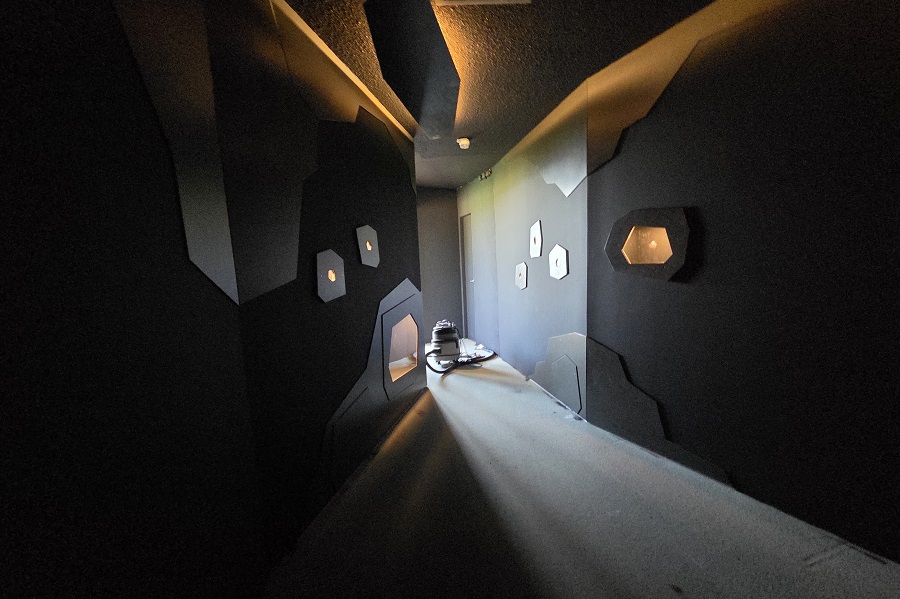
Exhibition space recreating a tunnel in the Huqoq hiding complex. Photo: Einat Ambar-Armon, Israel Antiquities Authority.
Watch a video about the site
here.
Heritage and Archaeology in KKL-JNF Sites
The ancient site of Huqoq lies within Ami'ad Forest, an open landscape managed by KKL-JNF in the Lower Galilee. At its heart is the perennial Huqoq Spring, around which settlement and agriculture flourished for centuries. In the future, visitors will be able to walk among the remains of the ancient village, discover the community that once lived here, and experience the site as a meeting place of nature, history, and landscape.
As part of its stewardship of Israel's open landscapes, KKL-JNF is committed to preserving, developing, and making accessible archaeological and heritage sites throughout the country. These landscapes contain the remains of ancient settlements, agricultural installations, public buildings, and other archaeological sites that tell the story of human life in the Land of Israel across thousands of years. KKL-JNF works in partnership to conserve and develop these sites, plan their surroundings, and prepare them to welcome visitors, while balancing heritage preservation with meaningful public access. Huqoq is a notable example of this approach.
Learn more about archaeology at KKL-JNF sites
The Story of the Village and Its Rediscovery
Excavations and archaeological surveys at Huqoq have revealed many aspects of daily life in the ancient village. Archaeologists have uncovered residential buildings and narrow streets, ritual baths (miqva'ot), water cisterns, and ancient roads. They have also identified quarries, agricultural terraces, and farming installations, including unique facilities for producing mustard oil. Beneath the surface, hidden chambers and burial caves on the outskirts of the village provide further evidence of the lives of Huqoq's inhabitants. At the foot of the hill, Huqoq Spring supplied water to the community for generations.
Parts of the village, including residential buildings and a ritual bath, were uncovered by the Huqoq Excavation Project. Other areas have been revealed in recent years through excavations conducted by the Israel Antiquities Authority, continuing to expand our understanding of the ancient settlement.
The exhibition presents a rich selection of artifacts used by the people who once lived here. Among the highlights are:
• Coin Hoard: Twenty-two bronze coins dating to 330–348 CE, most likely hidden during a time of crisis.
• Bronze Ring: Early 2nd century CE.
• Iron Knife: Possibly dating to the Bar Kokhba Revolt in the 2nd century CE.
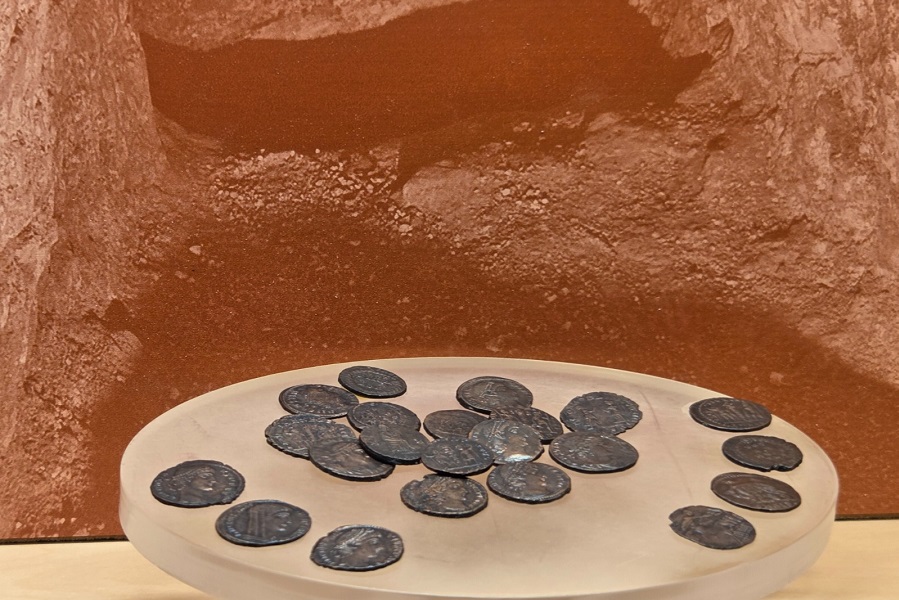
Coins discovered in the Huqoq hiding complex. Photo: Einat Ambar-Armon, Israel Antiquities Authority.
***
The exhibition also offers a variety of interactive experiences for visitors. These include "Writing the Next Chapter of Huqoq," where visitors are invited to share their ideas and hopes for the site's future development; reconstructions of Huqoq Spring, the village's primary water source, and a wine press that illustrates ancient wine production; a hands-on presentation of the ancient Mancala board game, and many additional activities designed to bring the story of Huqoq to life for visitors of all ages.
Visit the Exhibition
The exhibition is open to the public at the "Man in the Galilee" Museum, Yigal Allon Centre, Kibbutz Ginosar.
Opening hours:
Sunday–Thursday: 8:00–16:00
Friday and Saturday: By prior arrangement.
Admission fees:
• Adults: 40 nis (includes either a guided tour or self-guided visit)
• Discounted Admission: 20 nis for senior citizens, children ages 6–18, students, soldiers, and visitors with a disability card.
• Tour Guides and Group Escorts: Free of charge.
Accessibility:
• Accessible parking by prior arrangement.
• Accessible restrooms.
• Elevator access.
• Advance booking recommended for the best visitor experience.
Acknowledgements
Exhibition Curator: Dr. Einat Ambar-Armon
Scientific Advisors: Prof. Jodi Magness, Prof. Yinon Shivtiel, Dr. Shua Kisilevitz, Uri Berger, Shimona Sabag-Deri, Shlomo Ben Haim
Photography: Jim Haberman; Yaniv Berman
Exhibition Design: Token Studio