Located about six kilometers northwest of the Sea of Galilee and Capernaum, Huqoq was one of the thriving Jewish villages of the Galilee following the Bar Kokhba Revolt (132–136 CE), when the region became the principal center of Jewish life in Roman Palestine. Its proximity to Capernaum and Magdala also places it within the landscape associated with the ministry of Jesus and the emergence of early Christianity.
Excavation directed by Prof. Jodi Magness of the University of North Carolina at Chapel Hill revealed that the site was inhabited intermittently from the Early Bronze Age to the modern period, and that its greatest prosperity came during the Roman and Byzantine periods. The crowning jewel of the excavations was the discovery of an ornately decorated monumental synagogue that stood at the heart of the village. Built around 400 CE, this synagogue served for generations as a place of worship, learning, and community gathering.
The synagogue's floors are paved with spectacular mosaic panels that rank among the finest ever discovered in an ancient synagogue. Their rich artistic program combines biblical narratives, Jewish traditions, symbolic imagery, and a number of unique scenes unparalleled in ancient Jewish art. Together, they offer an extraordinary glimpse into the religious life, artistic creativity, and cultural world of Late Roman-Byzantine Galilee.
Among the best-known of the Huqoq mosaic panels are Samson Carrying the Gates of Gaza, Noah's Ark, Pharaoh's Army Drowning in the Red Sea, Jonah and the Fish, and the Tower of Babel, alongside many other remarkable biblical and non-biblical scenes that continue to reshape our understanding of Jewish visual culture in Late Antiquity.
The discoveries—particularly the synagogue's extraordinary mosaics, including scenes previously unknown in ancient Jewish art—have attracted worldwide attention and transformed scholarly understanding of Jewish communities in Late Antiquity.
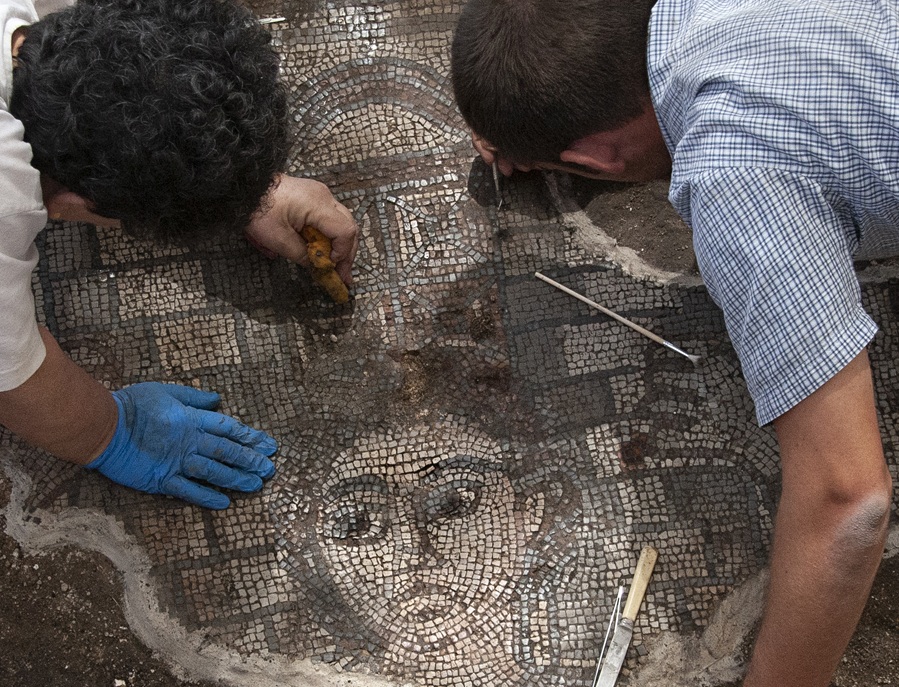
Preliminary on-site conservation of the Samson Carrying the Gates of Gaza mosaic.
Photo: Jim Haberman, Huqoq Excavation Project
Bringing Huqoq's Past to Life – As Part of the Freedom 250 Initiative
The conservation, documentation, and presentation of the Huqoq Synagogue are part of a broader effort to preserve the heritage of ancient Huqoq and make it accessible to the public. KKL-JNF, which manages the site, is leading the site's long-term development as a cultural and heritage destination.
The current project is implemented by the W. F. Albright Institute of Archaeological Research on behalf of the U.S. Embassy in Israel and the U.S. Department of State's Bureau of Educational and Cultural Affairs (ECA) as part of the Freedom 250 Initiative, commemorating the 250th anniversary of American independence. It is carried out in partnership with KKL-JNF, the Israel Antiquities Authority, and the Huqoq Excavation Project (University of North Carolina at Chapel Hill).
Founded in 1900, the W. F. Albright Institute of Archaeological Research is one of the oldest and most respected archaeological research centers in the Middle East. An independent, non-political, and non-sectarian American institution based in Jerusalem, the Albright supports scholarly research on the archaeology, history, and cultures of the southern Levant while fostering international academic collaboration and public engagement. Through the Galilee Heritage Project, the Institute brings its long tradition of scholarly stewardship to the preservation, interpretation, and presentation of Huqoq's remarkable archaeological heritage, making it accessible to audiences in Israel, the United States, and around the world.
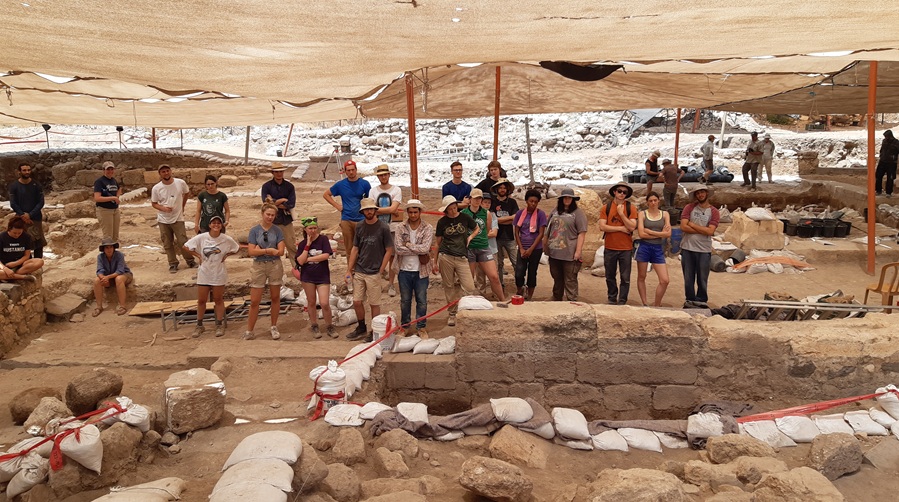 The Huqoq Excavation Project team, Summer 2019.
Photo: Shua Kisilevitz.
As the site will not be open to visitors for several more years, this digital platform offers an opportunity to explore the story of Huqoq and follow the discoveries emerging from the site. It will be updated periodically with news and insights from the ongoing project.
You can also experience Huqoq through the "Secrets of Huqoq" exhibition currently on view at the Yigal Allon Centre in Kibbutz Ginosar. Presented under the auspices of KKL-JNF and the project's partners, the exhibition is part of the broader effort to bring Huqoq's remarkable heritage to the public. Visitors are invited to discover the site's story through original artifacts, photographs, and immersive displays, including the original Samson Carrying the Gates of Gaza mosaic, displayed alongside other exceptional finds from the excavations.
The current project also includes the continued excavation and conservation of the synagogue, comprehensive digital documentation of the site, and high-resolution 3D scanning that will enable future virtual reconstruction and expanded digital access.
When the conservation and visitor development of Huqoq are complete, visitors will be able to experience this remarkable place firsthand. Until then, we invite you to discover its story through this website—and to follow the ongoing journey of uncovering one of the most extraordinary archaeological sites in the Galilee.
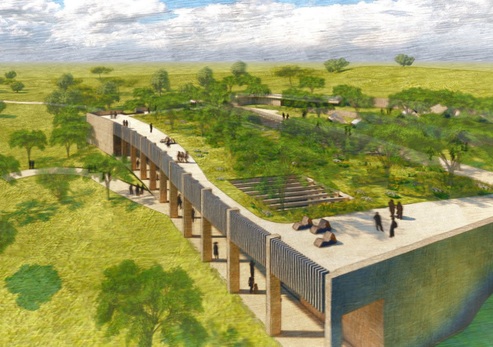 Architectural rendering of the future visitor center at the entrance to the site.
Design: Shlomo Aronson Architects.